
Why Is My Clothing Sample Wrong Even With a Tech Pack?
You sent your manufacturer a tech pack, reference sample, or other documentation you thought clearly communicated your product. Then the clothing sample arrives—and it's wrong.
Now you're left wondering what happened. Did the manufacturer make a mistake? Did I?
What you may not realize is that having a tech pack does not necessarily mean you're ready to start manufacturing. If you didn't provide samples and patterns with your tech pack, there is still information that needs to be clarified, and your manufacturer will work that out through sampling.
Many products are successfully developed this way, but if you expected the manufacturer to reproduce your design perfectly the first time, you may be surprised when the sample doesn't come back as expected.
Understanding that this can be a normal part of developing with a factory can help you determine what actually needs to happen next. When a sample comes back wrong, the cause usually falls into one of three areas: the product wasn't tested first, the documentation was unclear or incomplete, or the manufacturer didn't follow the specifications.
Need help with a project? Free expert guidance is just a click away.
Curious how sewn products are made? Learn more
1. It Wasn't Tested First
Sometimes the manufacturer makes exactly what you asked for, and the sample still doesn't work as expected.
Imagine that your tech pack specifies the size and placement of a zipper opening. The manufacturer uses the correct zipper, places it exactly where specified, and constructs the opening according to your instructions. When you test the sample, however, you discover that the zipper sits too high for the product to function comfortably.
Nothing was communicated or manufactured incorrectly. The zipper placement simply had not been tested in a physical sample before it was sent to the manufacturer.
If the manufacturer's sample is the first physical version of your product, it may reveal decisions that could not be fully evaluated on paper. Fit, proportion, range of movement, ease of use, pocket placement, closure function, material behavior, and construction methods may all need to be tested before they can be finalized.
In this situation, the manufacturer's sample is doing exactly what a development sample is supposed to do: giving you a physical product to evaluate so you can identify what needs to change.
A more detailed tech pack cannot necessarily prevent this type of sample revision. If a decision has not yet been physically tested, the information needed to make a better decision may only become clear once you have a sample to evaluate.
2. The Documentation Isn't Clear Enough

In other cases, you may know what you want, but the manufacturer does not have enough information to reproduce it accurately.
Having a tech pack does not automatically mean that every question about your product has been answered. Depending on what you provide, the manufacturer may still need to develop or interpret information in order to make your sample.
For example, a technical drawing may show a pocket, but does it establish its exact dimensions and placement? A measurement chart may list a 21-inch chest measurement, but does it define where and how that measurement should be taken? A zipper may be described as a "6-inch brass zipper with antique finish," but there may be several options that fit that description.
The pattern itself may also need to be created or refined. If you did not provide a finished pattern, the manufacturer may be developing one based on the measurements, drawings, samples, or other information you provided. That pattern may need to go through its own revisions as the product is sampled and evaluated.
When information leaves room for multiple reasonable interpretations, someone has to make those decisions. A manufacturer may use a construction method that is standard for its factory. A pattern maker may interpret the intended shape or fit. A sourcing team may select the trim that most closely matches the description.
The result may be reasonable and still be different from what you imagined.
That does not necessarily mean your tech pack is "bad." It may simply mean that the information needed to reproduce the product has not all been established yet. If the factory has to fill in those gaps, you are developing the product together through the sampling process.
The goal of clear documentation is not to put as much information as possible into a tech pack. It is to reduce unnecessary interpretation by clearly communicating the decisions that have already been made.
3. The Manufacturer Didn't Follow the Specifications
Of course, sometimes the manufacturer really did make something incorrectly.
If the product was tested, the information was clearly documented, and the manufacturer did not follow the specifications provided, the issue may be execution rather than development.
Perhaps the tech pack calls for a specific stitch type and the manufacturer used another. A pocket placement is clearly dimensioned but positioned incorrectly. The sample measurements fall outside the specified tolerances, or an approved trim was substituted without authorization.
Clear documentation gives you an objective reference for evaluating the sample.
Instead of saying, "The pocket looks too low," you can compare the sample with the documented placement. If the specification positions the top of the pocket 3 inches below a defined reference point and the sample measures 4½ inches, you can identify exactly where the discrepancy occurred.
This makes sample feedback more specific and helps separate something that still needs to be developed from something the manufacturer simply needs to correct.
4. The Pattern, Sample, and Tech Pack Don't Coincide
Even when you have a final pattern, an approved sample, and a tech pack, there can still be a problem if all three do not describe the same product because each communicates something different.
The pattern establishes the shapes and dimensions used to cut and construct the product.
The approved sample provides a physical reference for how those decisions come together.
The tech pack communicates the specifications and instructions a manufacturer needs to reproduce the approved result.
The final pattern should reflect the approved sample. The tech pack should reflect the final pattern and approved sample. And the approved sample should represent the product those documents describe. Together, the three provide a much stronger manufacturing reference: the pattern defines the product, the sample demonstrates the approved result, and the tech pack communicates the specifications needed to reproduce it.
How Do You Know Why Your Clothing Sample Is Wrong?
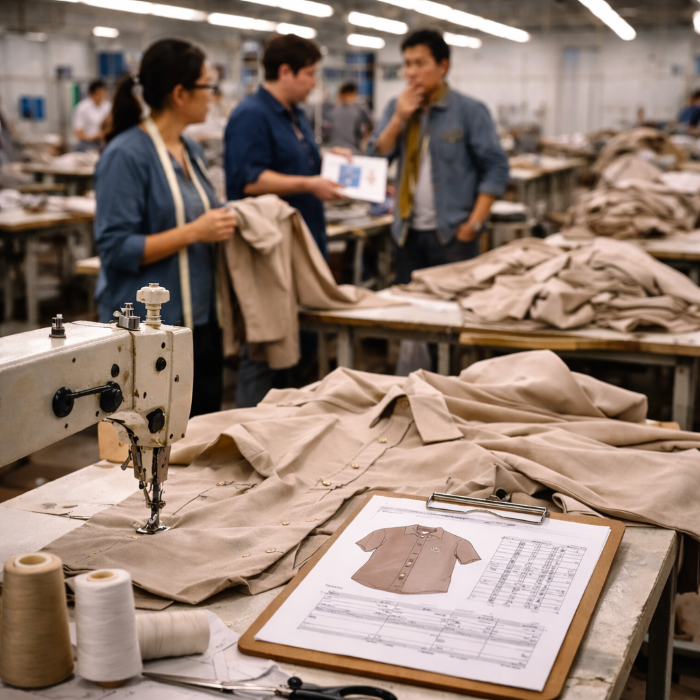
When a sample comes back differently than expected, start by asking what the manufacturer was working from and what you expected the sample to accomplish.
Did evaluating the sample reveal something about the product that you now want to change?
Was this the first time the product, pattern, construction, or materials were physically tested?
Did the manufacturer have enough information to produce one intended result, or did they have to interpret some of the details?
Did the manufacturer follow the specifications that were clearly provided?
The answers can help you determine whether the sample is part of the normal process of developing your product with the factory, whether additional information needs to be clarified, or whether the manufacturer needs to correct something that was not made according to the specifications.
Does a Good Tech Pack Reduce Clothing Sample Revisions?
Yes, a good tech pack can reduce avoidable sample revisions, but it cannot eliminate the sampling needed to develop decisions that have not yet been tested or established.
If you are developing your product with a manufacturer, product sampling is part of how those remaining decisions are made. Each round gives you an opportunity to evaluate the product, communicate changes, and move closer to the result you want.
If your goal is for a manufacturer to reproduce an already developed product, providing a final pattern, approved sample, and thorough tech pack gives them a much more comprehensive reference for your design before manufacture begins.
The important distinction is understanding which process you're in. A sample that comes back differently than expected is not always evidence that something went wrong. Sometimes it is simply showing you what still needs to be worked out before your product is ready to manufacture.
Do you need help getting your sample back on track?
Book a free consultation to discuss your product, identify where the disconnect may be happening, and clarify what needs to be addressed before your next sample round.

Want information like this sent straight to your inbox?
Sign up for our newsletter to receive the latest news, exclusive offers, and insights about our products and services.
You can unsubscribe at any time and we never share your information with anyone.

Frequently Asked Questions
-
A tech pack documents your product, but it doesn't tell you how much of the product has already been developed. If your pattern, approved sample, and tech pack are complete, the manufacturer can focus on reproducing your product instead of helping define it. That often creates a smoother transition into production and may reduce manufacturing costs by minimizing development work at the factory.
-
A good place to start is to ask yourself whether you already have a completed pattern, an approved sample, and a tech pack.
Having all three means you've completed product development. Instead of using the factory's sample to decide how the product should fit or function, you're evaluating the manufacturer's workmanship, capabilities, equipment, and ability to consistently reproduce your approved design before moving into production.
-
That depends on the role you want your manufacturer to play. If your product has already been developed, the manufacturer can focus on building it consistently. If important design decisions are still being made, the manufacturer becomes part of the development process.
-
Usually, yes, but more importantly, it changes what those revisions are for. Instead of revising the product itself, you're more likely to be evaluating manufacturing quality and identifying issues that need to be corrected before production begins.
Completing more development before manufacturing often shortens the path to production because fewer questions need to be answered through factory sampling.
-
Most sample revisions happen because the product still needed development, the documentation left room for interpretation, or the manufacturer didn't follow the specifications.
-
The goal isn't to provide the most documents; it's to provide the manufacturer with enough completed product development to accurately reproduce your design.
A completed pattern, an approved sample, and a thorough tech pack communicate your product from different perspectives, reducing interpretation and helping the manufacturer focus on producing a consistent result.